vibing

Why non-coding
architects are winning
the vibe coding era.

Vibe coding has taken over software development, and for the past year I have been doing it on weekends. Can you say nerd hobby?

The promise is simple. Describe what you want in plain English, and AI builds the application.

Predictably, the hot takes followed. Software engineering is obsolete. Anyone with a keyboard is a developer now. That misses the point entirely.

AI has not made engineering obsolete. It has shifted where the leverage lives. The bottleneck in software was never typing out syntax. It was achieving absolute clarity about what needs to be built.

In the AI era, the real power user is not the programmer who memorized syntax. It is the solution architect who does not write code.
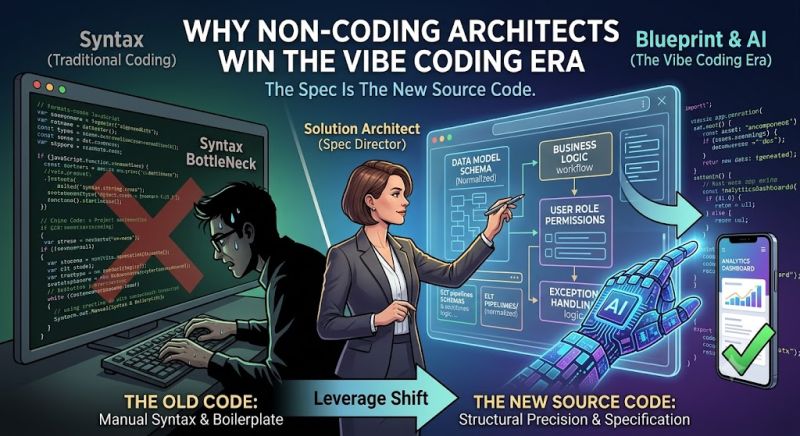
Split illustration contrasting two ways of building software. On the left, marked with a red X and labelled Syntax, traditional coding: a developer hunched over a screen of dense code, captioned Syntax Bottleneck. On the right, labelled Blueprint and AI, a solution architect stands at a bright panel directing a specification made of a data model schema, business logic workflow, user role permissions, and exception handling, which an AI hand assembles into a finished analytics dashboard marked with a green check. Across the bottom, an arrow labelled Leverage Shift runs from The Old Code, manual syntax and boilerplate, to The New Source Code, structural precision and specification.
The leverage moved. It used to sit in writing the syntax. It now sits in defining the thing precisely enough that the syntax becomes a formality.
it does not read minds

AI writes code. That is all it does.

Modern models are astonishing execution engines. They generate UI components, APIs, database schemas, and unit tests in seconds. But they operate under one unwavering rule: they only know what you tell them.

Vague requirements

Produce fragile, generic applications. The model has to build something, so it builds the average of everything it has ever seen. That is rarely what your organization needed.

Missing business rules

Produce broken edge cases. Every rule you did not state becomes a rule the model invented, and you will meet that rule later, in production, on a Friday.

Unstated data constraints

Force the model to fill the vacuum with assumptions. They will be plausible assumptions. They will also be wrong in exactly the places your data is weird, which is everywhere.

Garbage specification in

Garbage software out. The oldest rule in computing did not go anywhere. It just moved upstream, from the code to the description of the code.

the blueprint is the key

Software projects rarely fail because of bad syntax.

In enterprise data systems and cloud architectures, they fail because of ambiguous logic, poor data modeling, and misaligned workflows. I have watched it happen for twenty-five years and I have never once seen a project die because someone forgot a semicolon.

Before AI, executing business logic required hundreds of hours of manual coding. Today a model handles that mechanical execution in minutes. That shifts effectively all of the value to problem definition.

Solution architects, systems analysts, and product leads own this space because we think in systems rather than syntax:

Map the workflow before anyone writes code

What actually happens, who does it, in what order, and what breaks when someone is out sick.

Structure the data model and the relationships

Entities, keys, cardinality, and the ugly historical reasons a field means two different things depending on the year.

Anticipate the edge cases

The ones that trip up novice builders are the ones a domain expert can name from memory before the project starts.

Define acceptance criteria and security boundaries

What done means, and what the system is never allowed to do regardless of how helpfully it might offer.

specifications are the new source code

Think of it as a lightning-fast junior engineer.

This is the same reason I call mine my Artificial Intern. It produces code at warp speed and it lacks business context, intuition, and domain knowledge entirely. It needs an architect pointing at things.

When you treat AI as an implementation engine rather than a design engine, the output stops being a fragile prototype and starts being something you could actually put in front of a client.

Syntax is commoditized. Execution is automated. Specifications are the new source code. The people winning this era are not the ones who type fastest. They are the architects who know exactly what needs to be built.